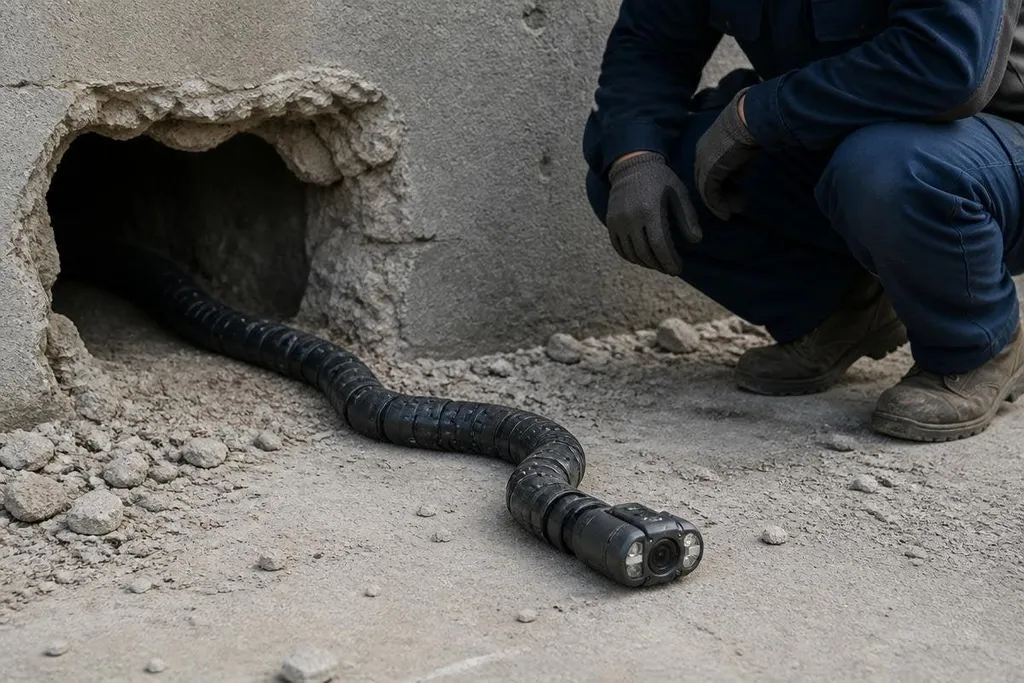
A snake robot can move through spaces that stop wheeled and legged machines. Its long body bends through a chain of powered joints, letting it reach into pipes, rubble, ducts, and other narrow areas.
For engineers, the appeal is clear: the robot can spread its body across uneven ground while keeping a camera or tool at the front. The hard part is making that motion reliable outside a clean demonstration.
Quick read
- Snake robots use linked joints to bend, push, and pull through tight spaces.
- Their long bodies can cross gaps and climb over uneven surfaces, but each joint adds weight and failure points.
- The useful test is whether the robot can carry a sensor or tool, return safely, and keep working after contact with the environment.
How the movement works
A snake robot usually has a series of short body sections joined by motors. Each joint changes the body’s angle, so the full robot can form curves instead of moving as one stiff frame.
That shape gives the robot several ways to move. It can push against the sides of a pipe, form a wave along its body, or lift part of its body over an obstacle.
The surface around it becomes part of the movement system because the robot needs contact to push against. Some designs move with a wave that travels from the head toward the tail, while others lift sections of the body in the air and place them down again.
Engineers call these patterns gaits, which means repeatable ways of moving. The control problem grows with every joint. A command that moves one section also changes the forces on the sections behind it. The robot needs sensors and software that can read joint position, body contact, and motor load while it moves.
Where snake robots can work
Pipes are a natural fit. A robot with cameras and lights could inspect an area that is too narrow, dark, hot, or unsafe for a person. A long body also lets it keep part of its frame outside the pipe while the front section reaches farther inside.
Rubble creates a different use case. In that setting, the robot can slide between blocks and search for people, cables, or damaged equipment. Its thin front section may reach places that a larger mobile robot cannot enter, while the rear sections keep sending power and data forward.
The same layout can help with industrial inspection. A front-mounted camera can look around bends, and a tool at the head could measure a surface or collect a small sample. The robot’s usefulness depends on the tool, not the snake shape alone.
Bending around a corner puts load on every joint and leaves little room for a weak motor or loose seal. Dated Robot24.com snake robot reports can give you named machines and test details to compare before the next section looks at those limits.
The limits are mechanical
A long robot needs many motors, cables, seals, and control links. Every added joint can increase weight and raise the number of parts that may wear out. A failed joint can also block the body behind it, especially inside a narrow passage.
Traction is another problem. Smooth floors may give the robot too little grip, while loose soil can swallow the force it needs to move. This design may work well on a rough test surface yet struggle on wet concrete or polished metal.
Power and communication also matter. The body may need a cable running back to the operator, which limits distance and can snag on corners. A battery removes that cable but adds weight, heat, and charging time.
The head needs protection too. Cameras and tools sit at the point most likely to contact an obstacle. A design that keeps moving after light contact has a better chance in inspection work, but that claim needs a test in the target site.
I'd judge a snake robot by its recovery after a stuck joint, not by a smooth video of it crossing a flat floor.
A practical buying checklist
Before choosing a snake robot for a real task, check these points:
- Space size: Measure the narrowest opening, bend, and vertical step the robot must pass.
- Surface contact: Confirm that the tracks, wheels, or body skin grip the actual pipe, floor, soil, or rubble.
- Head equipment: Match the camera, light, probe, or gripper to the inspection job before judging the chassis.
- Cable plan: Decide where power and data come from, then check every place the cable could catch.
- Recovery method: Ask how an operator retrieves the robot after a stall, loss of signal, or damaged joint.
- Service parts: Get the price and delivery time for motors, seals, cables, and the front sensor.
The best use for this design is a place where reach matters more than speed. Before purchase, ask for a trial in the real passage, with the real surface and the real tool, because that result will tell you more than a long list of joints.